
Future Meetings
Category: Newsletter
Oct
19

PLEASE JOIN US at the
2027 Spring SEA meeting in Minneapolis, MN featuring the theme:
“Honoring 100 Years of Anesthesia Education: Past, Present, & Future”
On April 16th – 18th
PLEASE JOIN US at the
2027 Spring SEA meeting in Minneapolis, MN featuring the theme:
“Honoring 100 Years of Anesthesia Education: Past, Present, & Future”
On April 16th – 18th
On “Hot – Off – the Press”, the Research Committee and JEPM (Journal of Education in Perioperative Medicine) highlight some key points from 2 recently published papers that every educator should know to enhance their teaching, administrative, or evaluative skills.
(#1).

We are living through a 21st Century Flexner Moment. Artificial intelligence is changing how knowledge is accessed, synthesized, and applied in clinical care. As technology becomes increasingly capable at pattern recognition, data synthesis, documentation, and decision support, medical education must become more intentional about the capabilities that remain central to the physician's role. Those capabilities include clinical judgment, communication, leadership, empathy, collaboration, humility, and trust. They depend on deep medical knowledge and on recognizing when technology is wrong or incomplete. The physician must become an augmented expert who can work effectively with technology while remaining accountable for the final clinical decision.
But there is an important tension in this transformation. The human capabilities that become increasingly valuable in an AI augmented world are also capabilities that require a particular kind of learning environment. This future requires space where people can acknowledge uncertainty, challenge one another, and speak openly. Psychological safety and civil discourse are part of preparing physicians to function safely in increasingly complex teams.
NEW to the SEA Newsletter is a section called – “the Resident’s Corner”. Thanks to the residents who have contributed to the first content pieces debuting this effort. We will highlight 1-3 write-ups in each Newsletter showcasing what residents are doing in the “Anesthesia Education” space relating to the theme of that conference.
During this Fall Meeting featuring the theme, “Innovations in Anesthesia Education: Integrating Pedagogy and Technology”, we kick off “the Resident’s Corner” with these 4 pieces ….
Are you part of a Committee? JOIN one of our committees today and contribute to the rapidly evolving landscape in Anesthesia Education. Learn of the exciting things going on at the grassroots level in your respective Committees.
The COACHING COMMITTEE, led by Drs. Karen Souter and Aileen Adriano
Hosts: Heather Ballard, MD. MS. and Chhina Anoop, MD.
Photos:
Established in 1996 through an initial contribution from Duke University’s Department of Anesthesia, this prestigious award recognizes individuals who have demonstrated a longstanding commitment to advancing the field of anesthesia education. In 2026, the Department of Anesthesiology, Pain Management & Perioperative Medicine at Henry Ford Health proudly assumed support of this honor.
The award recognizes educators who embody the core mission of the SEA: to Support, Enrich, and Advance anesthesia education and those who teach. Past recipients have distinguished themselves through curriculum development, technical innovation, scholarly writing, and educational research.
Multiple events and workshops occurred between the SEA Fall and Spring meetings. SEA members were able to engage in high quality educational activities and collaborative opportunities that focus on their career development as anesthesiologists and educators. Some of the activities hosted by SEA include:
NEW to the SEA Newsletter is a section called – “Hot – Off – the Press”. Thanks to the Research Committee and the Co-Editors-in-Chief of JEPM (Journal of Education in Perioperative Medicine), for taking the lead on this effort. We highlight 1-2 papers in each Newsletter that every educator should know to enhance their teaching, administrative, or evaluative skills – knowledge you need in your Toolbox.
We kick off Hot-Off-the Press with these two articles...
Learn of the exciting things going on at the grassroots level in your respective Committees and for those without a home – please JOIN one of our committees to contribute to the rapidly evolving landscape in Anesthesia Education.
In my fall newsletter, I described our "21st Century Flexner Moment," in which artificial intelligence (AI) is forcing us to reimagine medical education by doubling down on uniquely human skills like complex decision-making, ethical reasoning, and empathetic communication. As AI masters data and pattern recognition, our core value will increasingly be found in our ability to lead, collaborate, and connect. But this raises a critical question: can we cultivate these essential human skills in clinical learning environments that are too often compromised by incivility and psychological distress?
While we champion better teamwork and communication, our workplaces are frequently fraught with behaviors that undermine them. Research demonstrates that healthcare teams exposed to just “mild rudeness” show significant declines in diagnostic performance, procedural skills, and team collaboration. A 2023 review by Lewis found that incivility is directly associated with increased stress, declines in team performance, compromised patient safety, and poor quality of care, with junior staff more affected (1). In simulated anesthesia crises, residents exposed to incivility performed dramatically worse on critical management steps, with only 64% of the "rude environment" group performing at expected levels compared to 91% of controls (2). Cooper et al. reported that patients of surgeons with higher numbers of unprofessional behavior reports faced a 14% increase in complications (3). In the ASA Monitor, Swerdlow and colleagues identify harassment, incivility, and disrespect as the primary drivers of burnout, with anesthesiologists reporting the highest intent to leave academic practice compared to other specialties (4).
Over the past several months, the Precision Education (PE) Task Force, co-chaired by Larry Chu, MD and Viji Kurup, MD, has continued to advance several initiatives aimed at supporting innovation, collaboration, and data-informed training in anesthesiology education.
Standards and Data Infrastructure. The Standards Working Group has met regularly and, with leadership from Larry Chu, MD and Marianne Chen, MD, has developed a working prototype of a Program Director Precision Educator Dashboard. This prototype is being developed as part of the Task Force’s open-source Tequity in Anesthesiology Precision Education initiative. The group is also launching a Delphi process to define a basic shared, non-assessment common data set to support a pilot Federated Outcomes in Precision Education collaboration across programs. In parallel, the Assessment Working Group, led by Kenji Tanabe, MD, is initiating a Delphi process to identify a core set of Entrustable Professional Activities (EPAs) that could be federated within the Tequity pilot.
Generative AI for Teaching. The professional development working group led by Aileen Adriano, MD, with contributions from Erin Toaz, MD, Ngugi Kinyungu, MD, and colleagues is developing a practical, cross-platform “master prompt” framework to support point-of-care teaching with generative AI. The group has moved into beta testing, with members using different platforms (ChatGPT, Perplexity, and Claude) to generate teaching materials on a shared clinical topic – management of local anesthetic systemic toxicity – to compare outputs and refine a faculty-ready resource.
AI Education. The AI Working Group, led by Alex Goodell, MD, is developing an online course to help residents and faculty understand the emerging role of artificial intelligence in anesthesiology.
Educational Outreach. The Task Force continues to share its work through multiple channels. Four episodes of The Precision Educator podcast have been released to date (https://www.youtube.com/playlist?list=PLQcPkjS7dsrmPn6U19xm7u7_X3-etcTEc). In December, the group hosted a workshop for SEA members on using conversational AI tools to support precision coaching in medical education.
Together, these efforts reflect the Precision Education Task Force’s focus on building practical tools, shared standards, and educational resources to advance precision education across anesthesiology training programs.
Any SEA members interested in joining this effort are requested to contact [email protected] or [email protected] . We are an inclusive and supportive group seeking to find answers together to problems facing educators and trainees in anesthesia.


By Aileen Adriano, MD and Karen Souter, MB BS FRCA MACM PCC CMC
Coaching began to take on new significance in medicine with the shift toward competency-based education in the early 2000s. This shift made clear what many educators already understood: learners progress at different rates and along individualized pathways. Traditional models of mentorship and advising, while valuable, may not always address these differences. Coaching emerged as a structured, learner-centered approach that emphasizes reflection, goal setting, and growth—making it a natural fit for modern medical education.
21st Century Flexner Moment: Charting our Course through Medicine's AI RevolutionWalking through the AMA ChangeMedEd 2025 meeting, I felt the familiar tug of a Flexner moment. So much of the agenda, workshops, and posters leaned into AI as a force reshaping how we teach, assess, and practice. The message was unmistakable: if AI is now better at facts, pattern recognition, and organizing knowledge, then the uniquely human work of medicine must come into sharper focus.
The most promising future isn't one where AI replaces physicians, but where human-AI collaboration outperforms either working alone. This "human-in-the-loop" approach ensures quality and safety while leveraging AI's analytical power alongside human expertise, empathy, and ethical reasoning. In anesthesiology, this might mean AI systems continuously monitoring patient status and alerting us of subtle changes, while we focus on complex decision-making, patient communication, and leading the perioperative team. AI could handle routine documentation and administrative tasks, which are major sources of physician burnout, freeing us to focus on the aspects of care that require human judgment and connection.
NEW to the SEA Newsletter is a section highlighting COMMITTEE UPDATES. We highlight 13 Committees in this Fall Newsletter. Our goal is to increase awareness among our new and existing members and incite the desire to JOIN one of these Committees to contribute to the rapidly evolving landscape in Anesthesia Education.

April 4–6, 2025 | AT&T Hotel & Conference Center | Austin, Texas
The 2025 SEA Spring Meeting in Austin, Texas was a vibrant gathering of anesthesia educators from across the country. Centered around the timely theme “Doing More with Less in Medical Education,” this year’s meeting focused on how we, as educators, can continue to create meaningful learning experiences—even in the face of increasing demands and limited resources. From the opening remarks to the final workshops, the weekend was packed with practical strategies, engaging discussions, and a strong sense of community.
Program co-chairs Dr. Michael Hofkamp and Dr. Tina Tran curated a thoughtful and relevant agenda that addressed the real-world challenges we all face in academic medicine. Attendees explored innovative ways to maximize learner engagement, build effective leadership teams, and design curricula that are both impactful and sustainable. Conversations around educator wellness, peer coaching, and promotion pathways added further depth to the weekend, ensuring there was something valuable for everyone—regardless of experience level or institution type.

An Interview with Dr. Michael P. Hofkamp, M.D.
Associate Professor of Anesthesiology and Obstetrics & Gynecology
Baylor College of Medicine
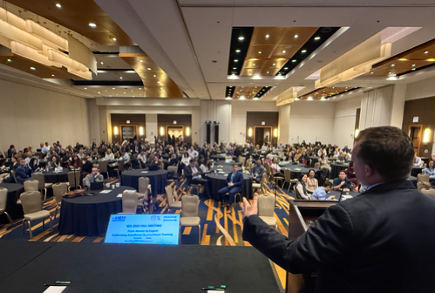
 The fall meeting of the Society for Education (SEA) in Anesthesiology in Chicago, IL on November 7th, 2024 was titled “The Year of the Educator.” The theme was chosen to highlight the need for and support of development and growth of members as educators. The SEA fall meeting took place the day before the Society of Academic Associations of Anesthesiology & Perioperative Medicine to allow residency and fellowship program leadership the opportunity to extend and expand their learning at both meetings.
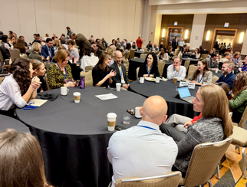
The meeting opened with breakfast roundtable committee meetings. This time to network and meet other educators is a highlight of every SEA meeting, with committees being open to any interested new members. This year, the start time was slightly delayed to 8 AM to accommodate those who arrived in Chicago late the evening prior and those from western time zones. Please let us know if you liked that change!
